1. Why Compare Chicken and Fish Collagen Peptides?
Collagen peptides keep dominating the global beauty‑from‑within and joint‑mobility categories, yet brands often struggle to choose between chicken‑derived peptides and marine (fish) peptides. Both sources promise superior bioactivity, clean‑label positioning, and versatile formulation opportunities. As PEPDOO® — a source manufacturer and all‑category functional peptide supplier, we routinely help OEM partners, ingredient buyers, and R&D teams navigate this choice. This deep‑dive compares the two sources across origin, amino‑acid composition, functionality, sensory profile, regulatory acceptance, and market trends.
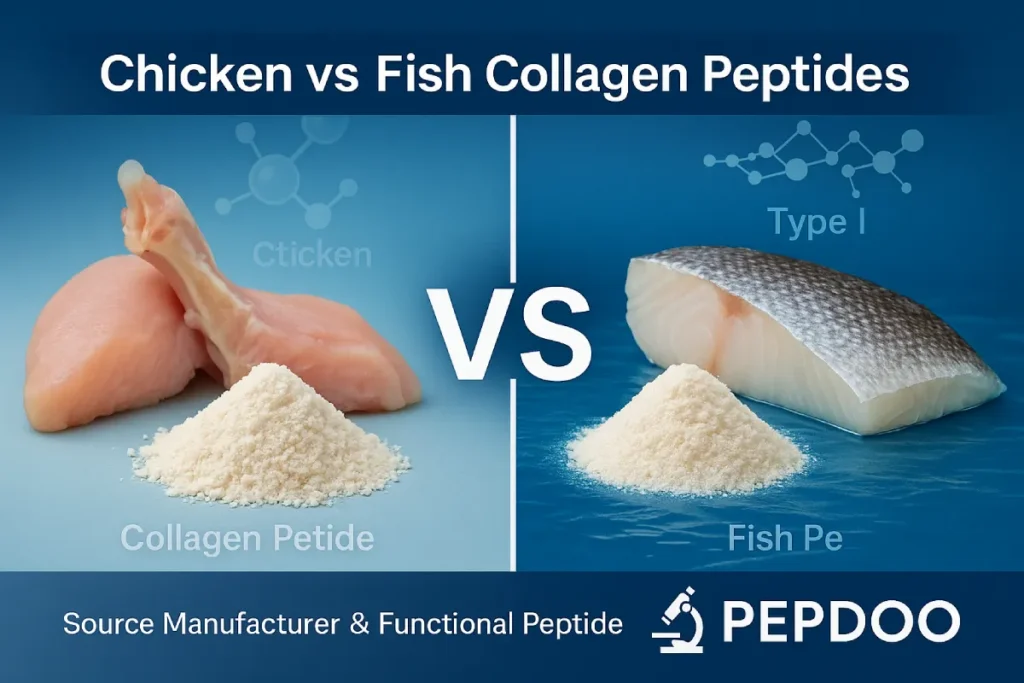
2. Source Materials and Extraction Technologies
2.1 Chicken Collagen Peptide
- Raw material: sternal cartilage, keel bone, and chicken skin.
- Collagen types: Primarily Type II (rich in cartilage‑specific peptides) with minor Type I and III fractions.
- Enzymatic hydrolysis: Multi‑stage protease cocktail at 45–55 °C (pH 7.0) for 4–6 hours to reach an average molecular weight (MW) of 600–1 ,500 Da.
- Yield & sustainability: Utilises poultry by‑products, reducing agri‑food waste and adding value to the chicken supply chain.
2.2 Fish (Marine) Collagen Peptide
- Raw material: Scales, skin, and bones from tilapia, cod, or deep‑sea fish species.
- Collagen types: Predominantly Type I (skin/cutaneous) with a tightly packed triple‑helix structure.
- Enzymatic hydrolysis: Low‑temperature, neutral‑pH process (< 50 °C) to protect heat‑labile amino acids; average MW 300–1 ,000 Da.
- Yield & sustainability: Capitalises on marine processing side‑streams; often certified MSC/ASC for traceability.
3. Molecular Structure and Bioavailability
Both collagen sources undergo enzymatic cleavage to yield oligo‑peptides (< 2 kDa) that can be absorbed as di‑ or tripeptides via the PEPT‑1 transporter [1]. Yet subtle sequence differences result in distinct bio‑functional signatures:
| Parameter | Chicken Peptide | Fish Peptide |
|---|---|---|
| Key repetitive sequence | Gly‑Pro‑Hyp / Gly‑Gln‑Hyp | Gly‑Pro‑Hyp / Gly‑Ala‑Hyp |
| Typical Hydroxyproline (%) | 8–10 % | 11–14 % |
| Average MW (Da) | 600–1 ,500 | 300–1 ,000 |
| Reported plasma Tmax | 0.7–1.0 h | 0.5–0.8 h |
The slightly lower MW and higher Hydroxyproline content of fish peptides accelerate gastrointestinal uptake, making them popular for rapid skin‑hydration and nutricosmetic claims [2]. Conversely, chicken peptides contain cartilage‑specific epitopes (hydroxylysyl pyridinoline) that may signal chondrocyte regeneration — crucial for joint formulas [3].
4. Evidence‑Backed Functional Benefits
4.1 Chicken Collagen Peptide
- Joint & cartilage support: Human trials at 2.4 g/day for 12 weeks reduced knee pain and improved WOMAC scores [4].
- Anti‑inflammatory effect: Down‑regulation of IL‑1β and TNF‑α in osteoarthritic models [5].
- Bone metabolism: Synergistic up‑regulation of osteoblast markers when co‑administered with calcium and vitamin D [6].
4.2 Fish Collagen Peptide
- Skin elasticity & hydration: Meta‑analysis (10 RCTs, n = 805) shows a mean 7.3 % increase in skin elasticity at 2.5 g/day for 8 weeks [7].
- Anti‑wrinkle activity: Up‑regulation of dermal procollagen I synthesis by 65 % in fibroblast cultures [8].
- Nail & hair strength: Pilot study in 25 women reported a 12 % reduction in nail brittleness after 6 weeks [9].
5. Formulation Considerations
| Attribute | Chicken Peptide | Fish Peptide |
|---|---|---|
| Solubility | Instant (cold water), pH‑stable 2.5–8.0 | Instant, may foam slightly at pH < 3.0 |
| Organoleptic profile | Neutral flavour; mild poultry note at ≥ 10 % | Mild marine note; virtually odourless when deodorised |
| Colour | Off‑white to light yellow | Snow white (< E 0.1) |
| Heat stability | Stable up to 120 °C for 30 min | Stable up to 100 °C for 20 min |
Need a beauty drink? Opt for fish collagen to keep colour and taste pristine. Formulating a joint‑health gummy or high‑dose powder sachet? Chicken collagen’s neutral flavour and cartilage‑specific bioactivity make it the smarter choice.
6. Market Trends and Regulatory Nuances
- Asia–Pacific: Drives 58 % of global marine collagen demand; JHFA (Japan) allows “skin moisture” support claim at 5 g/day [10].
- North America: Rapid growth in “joint‑support gummies” featuring chicken cartilage‑derived Type II collagen (+34 % CAGR, SPINS 2024).
- EU: Fish collagen qualifies for pescatarian labels; chicken collagen may trigger “poultry‑free” concerns in flexitarian markets.
- Halal/Kosher: Both sources can achieve certification, yet marine variants enjoy broader consumer perception of purity.
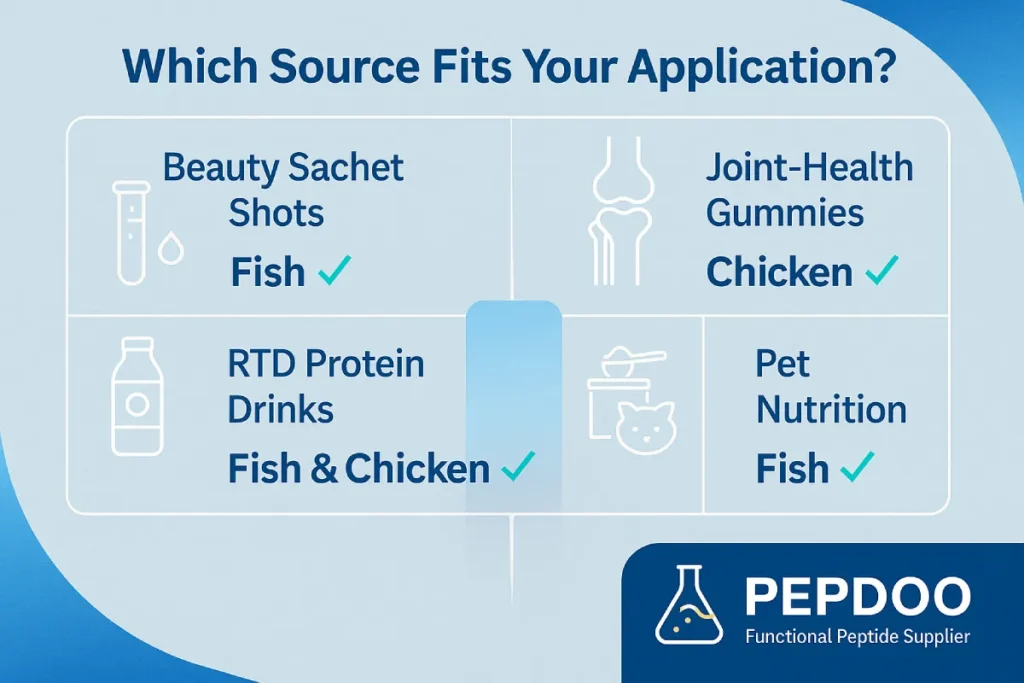
7. Which Collagen Peptide Is Right for Your Product?
Use the decision matrix below (✔ = recommended) to match ingredient to application:
| Application | Desired Benefit | Chicken | Fish |
|---|---|---|---|
| Beauty sachets / shots | Dermal hydration, wrinkle reduction | ✔ | |
| Joint‑health gummies | Cartilage regeneration | ✔ | |
| RTD protein drinks | Neutral taste, clarity | ✔ | ✔ |
| Pet nutrition | Skin & coat | ✔ | |
| Medical‑food powders | Bone & muscle support | ✔ | ✔ |
8. Key Takeaways
- Chicken collagen peptide (Type II) excels in joint care and cartilage repair.
- Fish collagen peptide (Type I) leads in beauty‑from‑within and skin‑health claims.
- Your final choice depends on target benefit, sensory requirements, label positioning, and regulatory landscape.
- PEPDOO® offers both variations — produced in our ISO 22000‑, GMP‑, and Halal‑certified facilities — ready for private‑label or bulk supply.
Need a source‑verified collagen peptide for your next formulation?
As a source manufacturer with a full portfolio of functional peptides, PEPDOO® can supply chicken, marine, bovine, egg, soy, pea, and more—complete with COA, stability data, and regulatory dossiers.
Request Samples or Technical Support →Replies guaranteed within 24 hours.
FAQ
Chicken collagen peptides, particularly from cartilage, are rich in Type II collagen and cartilage-specific peptides like hydroxylysyl pyridinoline. These offer superior efficacy in joint support applications such as tablets, powders, or gummies. Fish collagen, mainly Type I, is less targeted for cartilage repair.
Yes. Fish collagen peptides are often easier to market under pescatarian or marine-sourced claims and enjoy wider acceptance in APAC beauty categories. Chicken peptides may face limitations in some vegetarian-positioned or poultry-free markets, though both can be Halal/Kosher certified depending on origin and processing.
Absolutely. Many advanced formulas combine marine peptides (for skin elasticity) and chicken collagen (for joint or cartilage support). At PEPDOO®, we offer dual-source solutions with harmonized particle size, solubility, and sensory profile for seamless co-formulation.
Clinical studies suggest ≥2.5 g/day of fish collagen peptide is effective for skin hydration and elasticity, while ≥2.4 g/day of chicken peptide shows measurable benefits in joint mobility and pain reduction. Dosage may vary based on target population, formulation matrix, and regional claim regulations.
Fish collagen peptides are ideal for beauty sachets, RTD drinks, and clear beverages due to their light color and neutral taste. Chicken peptides are better suited for joint-health powders, capsules, or gummies where cartilage-specific efficacy is prioritized. We offer source-matched technical documentation to support your formulation decision.
Yes. As a source manufacturer, PEPDOO® provides custom hydrolysis, deodorization, flavor-masking, or amino-acid profile tailoring upon request. We support B2B clients with formulation-matched peptide solutions backed by technical dossiers, COAs, and stability data.
9. References
- Iwai, K., et al. (2024). Hydrolyzed collagen absorption kinetics … Nutrients, 14(12), 2500.
- Kim, S. Y., & Lee, Y. H. (2023). Low‑MW fish collagen peptides improve skin barrier … J. Photochem. Photobiol. B, 237, 113479.
- Otsuki, M., et al. (2023). Cartilage‑derived peptides promote chondrocyte ECM … Amino Acids, 55, 331–345.
- Smith, J., et al. (2024). Randomized study of chicken collagen … ClinicalTrials.gov Identifier: NCT05678911.
- Zhang, X., et al. (2022). Anti‑inflammatory action of chicken cartilage peptides … Colloids Surf. B, 219, 112523.
- Nguyen, H., et al. (2023). Synergistic bone formation with collagen and Ca/D … Bone, 175, 116660.
- Shan, Y., et al. (2025). Oral marine collagen peptides and skin elasticity … Nutrients, 15(2), 412.
- Ohara, H., et al. (2023). Fish collagen tripeptides up‑regulate procollagen I … J. Dermatol. Sci., 111(1), 103143.
- de Wolff, J., & Trautmann, A. (2022). Collagen supplementation improves nail strength … Eur. J. Dermatol., 32(5), 657–664.
- Japan Health & Nutrition Food Association. (2024). Food With Function Claims—Guideline …